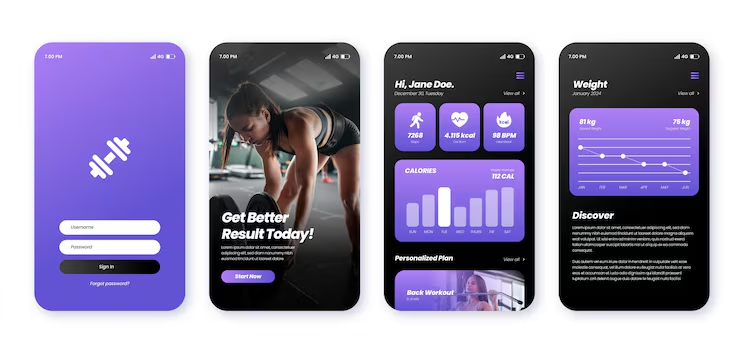
What are the major factors affecting fitness app development cost?
The total investment comes down to a handful of technical and strategic decisions. A simple app with a narrow feature set will always cost less than an enterprise grade platform, but the details matter more than that headline number.
The biggest cost drivers include:
- App complexity and number of features
- iOS and Android platform requirements
- UI and UX design quality
- Backend infrastructure and cloud hosting
- Third party integrations and APIs
- Development team experience
The more advanced the feature set, the more it costs to build and the more it costs to maintain afterward.
What actually drives the long-term operational costs of a fitness app?
Beyond initial development, hosting servers and cloud infrastructure are required to store user data, stream workout media, and manage backend traffic. You will also pay recurring fees for essential third-party APIs like payment processing, push notifications, and wearable device syncs. Finally, a portion of your budget must cover ongoing app store maintenance, security compliance, customer support, and user marketing.
The operational cost of app typically runs 15% to 25% of the original development cost per year for baseline technical maintenance, plus variable cloud, API, and user acquisition expenses as the app scales.
What Makes Remarkably Different Stand Out in Wellness and Fitness App Development Services?
Most development shops focus purely on writing code and calling the job done. So what actually separates a team that builds a working app from one that builds a business asset? At Remarkably Different, we start with a wider question: not just “can we build this,” but “will this still be generating revenue and keeping users engaged a year from launch?”
That mindset shapes everything we focus on:
- Business growth strategy
- User experience optimization
- Branding and positioning
- Performance-focused development
- Long-term scalability planning
We also believe high-quality development and budget-friendly pricing aren’t opposites. So how do wellness app development services stay both affordable and genuinely high quality at the same time? It comes down to building lean from day one, focusing your budget on what actually drives retention and revenue, rather than padding it with features or overhead that don’t move the needle for your specific business.

Our Fitness App Development Process
We keep the process straightforward, so you always know what’s happening and why. Here’s how it typically works:
- We discuss your app idea first. Before anything technical gets decided, we want to understand what you’re actually trying to build and who it’s for.
- We ask what features you actually want. Workout tracking, wearable syncing, live coaching, nutrition planning, whatever’s on your list, we map it all out before any technical decisions get made, so nothing gets missed or assumed.
- We talk about your budget, in detail. Your budget determines whether we build natively for iOS and Android separately or use a single cross-platform codebase, and it directly decides which of those features make it into your first version and which get planned for later.
- We suggest the right framework and tech stack for your budget, not the most impressive one, or the one we’re most comfortable defaulting to. The right choice depends entirely on what you’re trying to achieve and what you have to spend to get there.
- We give you a clear, realistic timeline based on the scope we’ve agreed on, so you know what to expect and when, before any development work begins.
We’ve built this process around one core belief: your budget shouldn’t be an afterthought you find out about once a quote lands in your inbox. It should shape the technical decisions from the very first conversation, so you never end up paying for a technical approach that was never right for your project in the first place.
Have a budget in mind but not sure what it can realistically build? Let’s find out together.
Design and user experience considerations
User experience might be the single biggest factor in whether a fitness app succeeds or gets deleted within a week. Bad design tanks retention fast.
People expect fitness apps to deliver:
- Smooth navigation
- Fast loading speed
- An interface that actually looks good
- Personalized dashboards
- Effortless workout tracking
Good UI and UX design takes more planning, testing, and development time, which does add to the budget. But it is usually the best money spent. A better experience means people stick around longer, and that is where the real return shows up.
Development approaches and budget differences
Businesses have a few paths to choose from depending on budget and goals when working with the best fitness app development company for the job.
Native development for iOS and Android tends to deliver the smoothest performance, but it costs more since each platform needs its own build.
Cross platform frameworks can bring the initial cost down by letting developers write one codebase for multiple platforms. Some advanced features may still need extra work to run well on both.
It is also worth planning for what comes after launch. The operational cost, hosting, server maintenance, bug fixes, app store updates, ongoing wearable API changes, adds up over time. This should be part of the budget conversation from day one, not an afterthought once the app is live.
The role of AI and wearable technology in modern fitness apps
AI and wearable integration have gone from nice extras to genuine differentiators.
AI powered systems can offer:
- Personalized workout recommendations
- Smart nutrition suggestions
- Behavioral analysis
- Automated coaching
Wearable integration with devices like Apple Watch and Fitbit boosts engagement too, letting users see real time health data and keep their activity synced across devices.
These features add real value, but they also add real complexity, and that shows up in the final price tag.
Why strategy matters before development begins
A lot of businesses jump into development without a clear plan. It almost always costs them later, in wasted development time, delayed launches, or a product that never quite fits the market.
Before writing a single line of code, it is worth nailing down:
- Who the app is actually for
- What the core functionality needs to be
- How the app will make money
- What makes it different from competitors
- Where it needs to scale over the next few years
A clear strategy upfront saves money down the line. It keeps the whole team focused on the same roadmap.
Ready to build your fitness app?
If a fitness app is on the roadmap but the strategy, features, or long term scalability are still open questions. Now is the time to bring in a partner who has done this before.
Remarkably Different builds fitness apps focused on performance, engagement, branding, and sustainable growth. The goal is not just writing code, it is building a product that can actually compete in today’s fitness market.
Start building your next fitness app with Remarkably Different and turn your idea into a platform that scales.